What is passage-paysage? (1) Fields of Potential: Rethinking Landscape Beyond the Visual
Infrastructure and streets are the backbones of Baukultur, shaping the public space where people, goods, and ideas intersect. Yet in many European cities, over half of this space is primarily dedicated to cars, limiting its potential to serve as thriving public places. What would happen if we redefined roads not just as routes, but as places of social cohesion and ecological resilience? This project will develop a series of visions and future scenarios to redefine Swiss cantonal roads into passage-paysages: green, multimodal infrastructures that prioritize active mobility, territorial connectivity, sustainability and people’s sociocultural experiences. By thinking about these roads otherwise, we can promote sustainable mobility, healthier lifestyles, and dynamic public areas that reconnect people with their local environments.
In this series of posts around the notion of passage-paysage, we want to convey the relevance of roads and streets for Baukultur and the singular qualities of these spaces. Our first posts will help us rethink landscape from visual or picturesque approaches to fields of potentialities and trace some historical precedents for the term passage-paysage, looking at instances where the street and/or the road where conceived and experienced not merely as functional elements of the city, but as architectural devices, where the entanglement of nature and culture, the affective engagement with place and the experience of mobility as (also) a symbolic act helped define meaningful urban and territorial aesthetic experiences. In subsequent posts, we will see how this precedents help us challenge the modernist paradigm of urban and infrastructural planning or how the passage-paysage notion pushes for holistic mobility experiences and inclusive and adaptive design strategies oriented towards the development of healthier and more biodiverse cities. This series of texts are extracted and adapted versions of our previous work around passage-paysage. They help us set the stage for the current project, as we begin to look further into the specific history of cantonal roads and the potentialities of passsage-paysage to contribute to a high-quality Baukultur.
Fields of Potential: Rethinking Landscape Beyond the Visual
“The term landscape no longer refers to prospects of pastoral innocence but rather invokes the functioning matrix of connective tissue that organizes not only objects and spaces but also the dynamic processes and events that move through them.”
—Alex Wall
In 2007, forty years after Robert Smithson did his Tour of the Monuments of Passaic, New Jersey, Kazys Varnelis went through all its stops, in-between “urban residue, deliberately left behind” by the process of deindustrialization suffered by the city during the previous twenty years. Back in 1967, these places, from the bridge connecting Bergen County with Passaic County to a children sand box, “a map of infinite disintegration and forgetfulness”, held nonetheless some form of expectation of things yet to come. In 2007, Varnelis wonders where all those “places of potential and excitement, generating freedom by embodying absence” have gone, as he realizes “today’s Passaic is neutralized, its potential depleted (and) its spaces overspecified”.
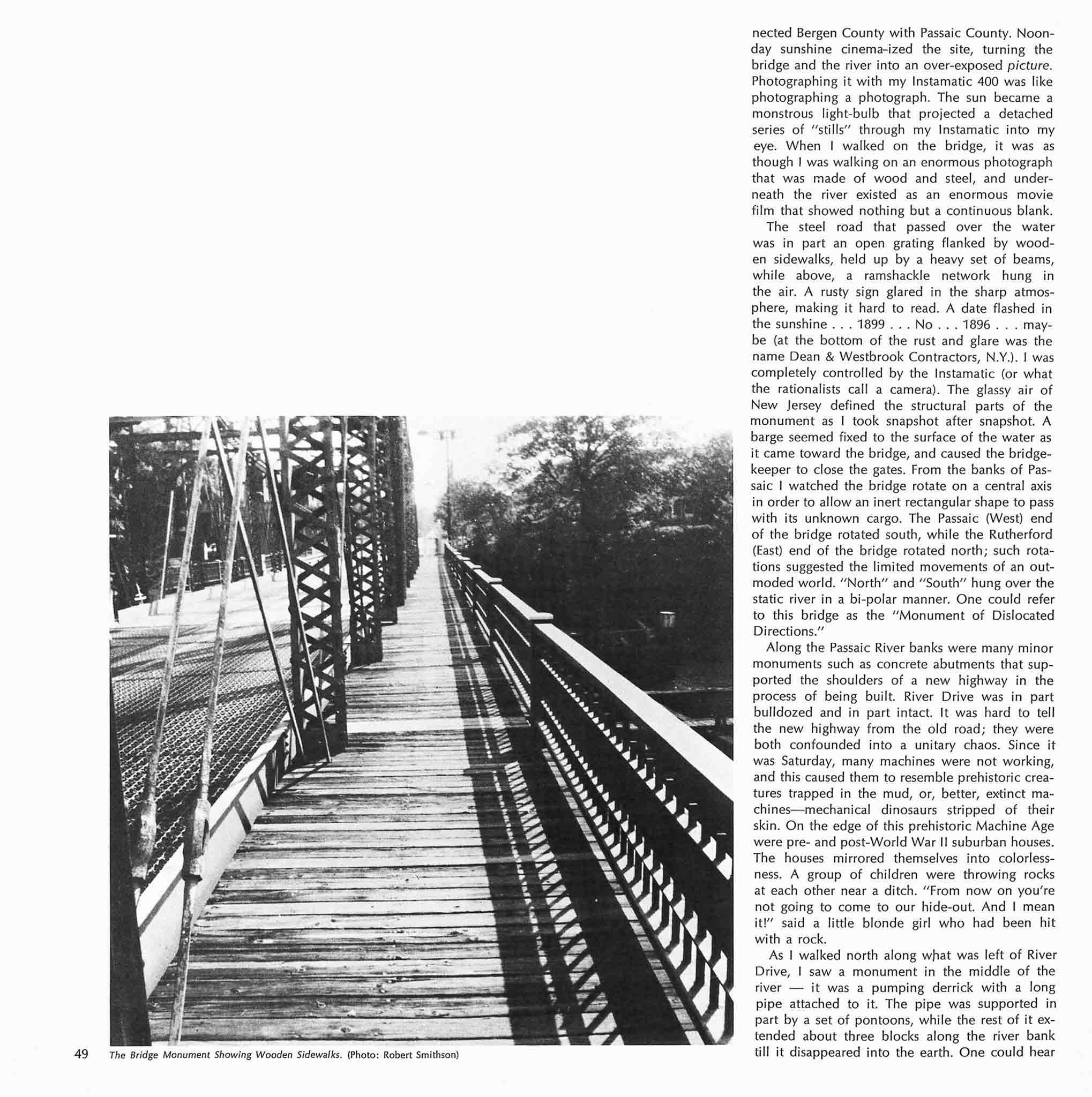
The territories captured by Robert Smithson were echoed in the terrain vagues, the voids and nothingness, the drosscapes or the brownfields of our urbanized realm. All these territories (and operational figures) defined the site in terms of its potentialities and the plural temporalities they held. Opposite to the traditional resource model of planning where a potential is only considered in terms of its consumption through actualization, they underlined these potentialities’ infrastructural and open-ended nature. These sites’ internal dynamics have proven capable of launching bottom-up and emergent socioecological processes, without the need of an over-determining plan, program, design, or external action. In these sites, collective memories and future imaginaries appear entangled in a non-linear way, feeding each other beyond traditional models of causality or historicity. They thread ecological realities that, rather than theatrics and representation, demand operational care and mutual engagement in plural temporalities and more-than-human terms.
These potentialities resist representation. Often when territories as Smithson’s Passaic are pictured, they excite romantic reconsiderations of the ruin: Detroit’s “ruin porn” resonating with the fabricated ruins of the English landscape garden. In one of his last texts, Gilles Deleuze wrote about “the cloud of virtual images” surrounding all actual objects. An unrepresentable, immeasurable and dynamic fog, but nonetheless an effective fog. This cloud plays an essential role in the modulation and transformation of our cities, as well as in the individual and collective experience of their spaces. These virtual images operate as traces, beginnings, demanding material gestures capable of intensifying their presence. To consider this entanglement we have defined elsewhere an affective image, touching the body beyond the visual.
This affective image offers us a path toward an operative redefinition of landscape, one that takes us from the 17th century paintings at the beginning of so many landscape histories to the older definition of landschaft as a form of commons emerging out of shared practices, customary law, and the inherent dynamism of the land. By thinking of landscape as the entanglement of nature, material practices and meanings, a form of commons organizing and supporting the spatiality of more-than-human communities, we seek to find new instruments to make this affective image operative within our architectural practice.
The concern for landscape’s possibilities to work with a complex urban condition emerged at the end of the 19th century, when figures such as Patrick Geddes, Adolphe Alphand or Frederick Law Olmsted, advanced proposals to articulate the new urban condition born out of the industrial revolution through an operational approach to nature. Parallel to the growing presence of engineering in planning, the specialization of urban and territorial planning as branches of the social sciences, and the architectural penchant towards masterplanning, landscape “with its capacity to encompass sites, territories, ecosystems, networks, and infrastructures, and to organize large urban fields” emerged as a key operational tool to intervene in our territories. From Vittorio Greggotti’s reclamation of the territory for architecture to landscape urbanism, or more recently, landscape infrastructure , landscape offers a way forward to pair the synthetic qualities of the design disciplines to keep our territories culturally relevant; with the ecological and technological know-how needed to address their dynamic condition and technoecological entanglement, as well as the openness to foster adaptive and politically inclusive processes.
Stan Allen’s Infrastructural Urbanism, published in 1999, echoed these concerns by reclaiming architecture as a material practice, “as an activity that works in and among the world of things, … (marking) a return to instrumentality and a move away from the representational imperative”. Accordingly, he focuses on the infrastructural and how it “works not so much to propose specific buildings on given sites, but to construct the site itself,” meaning that its key role is the preparation of the ground, creating the conditions for new realities to take place. Other theorists and practitioners as James Corner or Alex Wall have expanded this infrastructural notion tying it to landscape and describing its practice as the “staging of surfaces”.
Although we will talk instead of the preparation of the site rather than of the surface to go beyond theatrical and/or flattened readings of the landscape, and fully consider the overlapping layers and temporalities constituting it as a shared political ground with infrastructural qualities , the aforementioned considerations remain important. Preparing a site means increasing its capacity to support, and widening, rather than restricting, the possibilities, as affordances, it can hold and actualize. This is done by avoiding over determination, so instead of designing closed forms and/or programs, active forms and oriented fields are required . Preparing a site implies thinking in terms of services, rather than functions, for instance, establishing points of access to the other networks so that new activities or plans can unfold. Preparing a site means assuring a systemic coherence—ecological and functional, but also symbolic—, while allowing for difference to emerge all throughout. Preparing a site means setting the framework for the collective enunciation of the city: conceptualizing it, representing it, analysing it, as a common ground where the different knowledges and voices of the polis can be assembled. Preparing a site means harmonizing its plural temporalities, movements, and rhythms, by making them affectively graspable to its users and developing transformation strategies capable to adapt and leverage the rich temporality of any given site . Preparing a site means understanding how our cognitive processes, from orientational know-hows to imagination, are supported by the environment and can be operationalized to support, trigger, and expand deeper socioecological entanglements . Preparing a site means working in a transcalar, or even a post-scalar approach , to consider cascading and capillary spatial effects, parallel structures, redundancies, nested patterns, and all forms of ecological entanglements in their diagrammatic and productive level . Preparing a site means attending to its human and non-human performances, unveiling the practices shaping it and the tacit knowledges therein inscribed to activate them and encourage non-technological forms of urban intelligence . Preparing a site finally means rendering political the artificiality of its nature, where biological milieu and informational media, are inextricably entangled… It is onto that preparation, that we want to push our architectural work to focus, so that the site’s supportive qualities can emerge in a strategic way and with a “performative over compositional logic”.
[Excerpted from the book Passage-Paysage (EPFL Press, 2023)]